





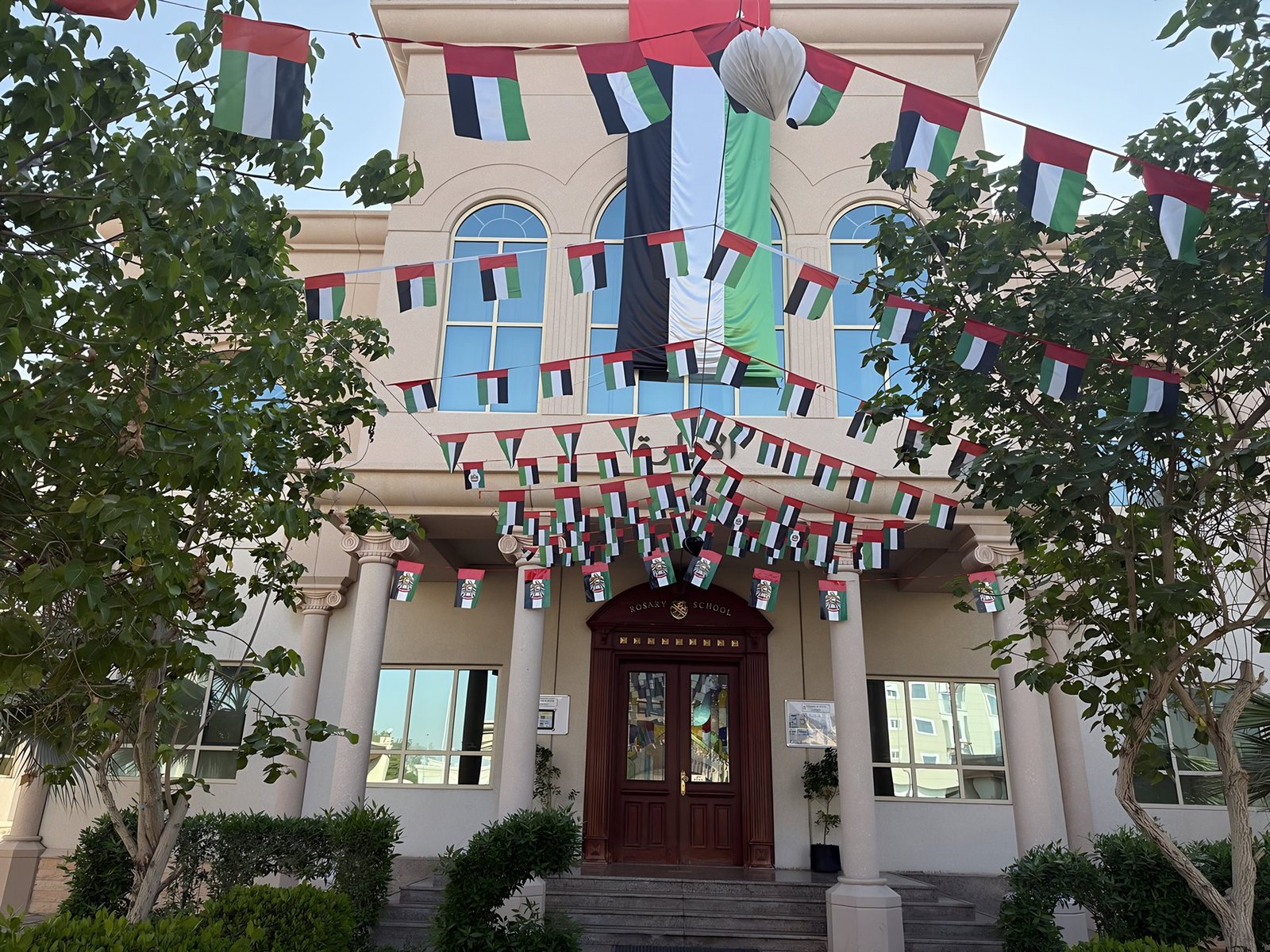
Rosary Private School — Sharjah, Muweilah
These regulations define student and parent duties, school responsibilities, and the rules governing conduct, protection, learning and services. Each party must fulfil the duties within their role. Breaches are recorded and addressed through defined, reasoned procedures within authorised powers.
Part I — General provisions and application 12 provisions
- G01
Scope and application
The regulations concern Rosary Private School, Sharjah–Muweilah Branch, within its licensed stages from FS2 to Year 13. Following approval, they apply to students, parents, employees, volunteers and contractors according to each policy’s scope and their responsibilities. They do not automatically apply to another branch.
- G02
Compliance and implementation responsibility
Each party must fulfil the duties within their role. The policy owner is accountable for implementation, records and correction. Naming a role does not itself delegate authority. These regulations do not create a power to impose sanctions, collect charges or disclose data without an applicable basis and authority.
- G03
Applicable requirements take precedence
Current legislation, decisions, circulars and competent-authority requirements apply within their scope. Any conflicting internal provision must be suspended and the resolution recorded. General wording must not exclude a mandatory duty or liability that cannot lawfully be excluded.
- G04
Curriculum, stages and examinations
The regulations operate within the British curriculum, licensed stages, authorised examination-body rules and applicable national and local requirements. Assessment weights and admission conditions from another curriculum must not be adopted without an applicable basis.
- G05
School rights and preservation of evidence
The school protects its rights through prevention, clear agreements, reasoned decisions, recorded facts and preserved evidence. Concealment, alteration of evidence, backdating and blanket waivers of rights are prohibited. Lawful reporting and access to the competent authority remain available.
- G06
Authority and conflicts of interest
Signing, spending, settlement and representation powers must be documented in writing. No person may investigate a complaint against themselves or approve a transaction involving their own conflict of interest. Matters concerning the Principal go to the governing body or its independent appointee; mandatory external reporting continues.
- G07
Priority of protection and urgent response
Protection, first aid and mandatory reporting take priority over forms and internal approval. An absent lead or incomplete proof must not delay a child-protection response. The school must appoint leads and deputies and communicate current reporting channels.
- G08
Contracts and specific permissions
Circulating the regulations does not automatically amend an existing contract. Changes must follow the applicable process, with specific permissions recorded where required. Silence is not consent to optional photography or publication, and refusal must not restrict education or fair treatment.
- G09
Records, confidentiality and retention
Each owner must maintain the required records with need-based access and an approved retention schedule. Disposal is suspended for an existing or reasonably anticipated investigation or claim. Personal data and individual cases belong in restricted internal files and must not appear in this public document.
- G10
Timescales and notification channels
A working day is an actual school working day under the approved calendar. Internal periods start on the first working day after recorded receipt. School timescales do not extend statutory, contractual or competent-authority deadlines. ORISON and official channels support routine communication; urgent matters require direct contact.
- G11
Accountability and exceptions
Breaches must be recorded and addressed through proportionate, reasoned action after hearing the person concerned and preserving appeal rights. Sanctions, removal, registration changes or financial deductions require the applicable basis, authority, procedure and approval. Internal exceptions must state their reason, duration and approver and cannot bypass safeguarding or regulatory requirements.
- G12
Language, review and commencement
Arabic and English are intended to convey equivalent meaning; the Quality Lead and specialist must record corrections to discrepancies. Statutory language rules apply within their scope, and translation errors cannot override mandatory rights. Review is annual and on material change. The school’s approval decision sets the edition’s effective date; existing legal duties and approved procedures continue beforehand.
Part II — Detailed policies and procedures
Open a policy to read its scope, responsible role, all clauses and monitoring requirements.
P09Child protection and reporting concerns11 clauses
- Responsible role
- Designated Safeguarding Lead
- Scope
- Students, staff, volunteers and contractors in school, transport, activities and related digital environments
Policy commitment
The child’s safety and best interests shall guide the response. The school shall appoint a safeguarding lead and deputy and publicise reporting channels. Suspicion is sufficient to initiate a report; proof of abuse or consent from the family or management is not required. Risk shall determine the speed of referral, with an immediate response to urgent danger.
Rules, duties and procedures
- 9.1
When a child discloses a concern, staff shall listen calmly, avoid promises of absolute confidentiality, and neither interrogate nor suggest answers. The child’s own words shall be recorded as closely as possible, with the date and time.
- 9.2
Staff shall protect the child from immediate danger and notify the safeguarding lead or deputy immediately. In an emergency, they shall contact the competent service without waiting to complete a form.
- 9.3
The safeguarding lead shall assess risk and refer through the current competent-authority route, recording the reporting time, recipient and decision. A school committee shall not replace the child-protection authority’s investigation.
- 9.4
A support and follow-up plan shall be established with clearly defined authority. If contacting the family could increase the child’s risk or affect an investigation, the timing of notification shall be determined in coordination with the relevant specialists.
- 9.5
A concern involving the safeguarding lead shall bypass that person and be referred to the deputy or Principal and competent authority; a concern involving the Principal shall go to the governing body and competent authority. Urgent referral shall be immediate, with records completed without delaying it. Named leads, deputies and channels shall be maintained in a current internal contact list.
- 9.6
If the safeguarding lead or deputy is unavailable, implicated or fails to take the necessary action, the person receiving the information shall report directly to the competent authority according to the risk and applicable duty, without waiting for permission or complete proof. The recipient shall securely record the time and receiving authority; completing the child-protection concern record shall not delay reporting.
- 9.7
If the safeguarding lead is absent or implicated, the report shall be escalated directly to the deputy and competent authority. The school shall publicise Sharjah’s child helpline, 800700, and protect anyone who reports a concern in good faith.
- 9.8
The school shall publish accessible ways for students, families and staff to reach the safeguarding lead, deputy and external reporting channels, adapted to age, language and need. Staff shall receive training on physical, sexual and emotional abuse, neglect and reporting procedures, with participation and updates recorded. Training, forms or internal permission must never delay protection or required reporting.
- 9.9
Safeguarding concerns include physical, sexual, psychological or emotional abuse and neglect. Unexplained injuries, fear, sudden withdrawal or marked changes in sleep, eating, behaviour or attendance may require reporting and professional assessment. Indicators are not proof or a diagnosis; staff shall not use derogatory labels for a child or assumptions based on family disability or economic circumstances.
- 9.10
Receiving a disclosure is limited to listening and the open questions necessary to understand the urgent need, without interrogation or requiring repeated accounts to several people. The recipient shall record the location, date, time, people present, the child’s words, any visible injury and action taken, distinguishing direct observation from reported information or opinion.
- 9.11
A required report shall not depend on the Principal’s or Student Affairs Committee’s permission, completion of an internal investigation or final classification of the case. The social worker and safeguarding lead shall support the child, preserve records and cooperate with the competent authority within their roles; they shall not confront a suspect or gather evidence in a way that endangers the child or investigation.
Records, oversight and monitoring
the child-protection concern record; chronology; referral and acknowledgement of receipt; support plan; and restricted training register. Receipt and handling of reports and all staff understanding shall be checked. Reduced report numbers shall not be a performance target.
P10Anti-bullying and peer-on-peer harm10 clauses
- Responsible role
- Student Affairs Lead
- Scope
- Student interactions and behaviour in school and outside school when they affect the school
Policy commitment
The school shall address physical, verbal, social and online bullying, repeated harm and imbalances of power, and shall also respond to serious one-off incidents. Harm need not be repeated before protective action begins.
Rules, duties and procedures
- 10.1
Staff receiving a report shall protect the affected student and notify Student Affairs. Serious harm, sexual concerns or blackmail shall be referred to the safeguarding lead immediately.
- 10.2
The team shall hear the parties separately and gather evidence without forced confrontation or circulation of harmful images or messages, recording the impact and context.
- 10.3
A safety plan shall support the affected student, an intervention shall address the behaviour of the student responsible, and witnesses shall receive follow-up. Families shall receive information about their own children without disclosure of others’ data.
- 10.4
As an internal procedure, the case shall be reviewed after one week and again within one month, including recurring locations, times and supervision. It shall be reopened if harm or retaliation continues.
- 10.5
The school shall assess power imbalance, repetition and retaliation risk through safe separate interviews. Serious one-off harm may require a safeguarding referral regardless of whether it meets a bullying definition. The school shall not compel the affected student to confront the other party or enter mediation.
- 10.6
Reconciliation or a direct apology shall not be imposed when it would increase harm. The safeguarding route and appropriate accountability procedures shall be applied, with a right of appeal.
- 10.7
Bullying includes intentional harmful behaviour involving a power imbalance and repetition or persistence; a single digital post may have continuing effects through sharing. Forms include assault, threats, ridicule, exclusion, rumours and abuse related to religion, nationality, culture, disability, appearance or health. Every one-off incident of harm shall be addressed seriously even if it does not meet the definition of bullying.
- 10.8
The response covers messages, images, videos, calls, social platforms and online games, in or outside school where they affect the school community’s safety or learning. Preserve evidence securely without redistributing harmful content, apply P27 and P29, and refer risks or possible offences through the competent route.
- 10.9
The anti-bullying committee shall establish an annual prevention plan covering awareness, training, supervision of recurring locations, and student and parent participation. Each term it shall review case patterns, responses and intervention effectiveness, reporting aggregated findings to leadership without identifying students. Fewer reports alone shall not be treated as evidence of success.
- 10.10
Age-appropriately, students shall not participate in, encourage or redistribute harmful behaviour and shall seek a trusted adult’s help when witnessing it. Parents shall report through official channels and support follow-up. Teachers, support staff and bus supervisors shall report promptly and record facts; a child witness shall not be asked to investigate or intervene in a way that puts them at risk.
Records, oversight and monitoring
the behaviour record and follow-up plan; restricted evidence; safety plan; family communications; and records of follow-up and any recurrence. Monitoring shall cover the start of protective action, the affected student’s sense of safety, recurrence and the effectiveness of reporting channels. Prevention plan, case log, pattern and supervision reviews and follow-up.
P11Student behaviour and school discipline32 clauses
- Responsible role
- Student Affairs Lead, under the Principal and educational committee
- Scope
- Rosary Private School – Muweilah, Sharjah community within this policy’s scope
Policy commitment
Rosary Private School – Muweilah, Sharjah adopts this policy to protect its community’s safety, learning continuity, school rights and property through clear expectations, fair educational intervention and documented decisions. Authorised staff shall implement it within SPEA requirements; it creates neither powers not otherwise conferred nor a blanket exclusion of liability.
Rules, duties and procedures
- 11.1
School-specific scope: This policy applies to Rosary Private School – Muweilah, Sharjah students in licensed stages from FS2 to Year 13, and to implementing staff and parents within their responsibilities. It covers school premises, transport, trips, activities and school platforms, and an external incident with an evidenced direct connection to school-community safety or learning. It does not authorise general oversight of private life.
- 11.2
Respect and responsibility: Students shall respect peers, staff and visitors, national identity, community values and diversity, and use appropriate language. They shall follow authorised staff instructions concerning learning and safety. A student may seek clarification or report unsafe instructions without retaliation.
- 11.3
Attendance and readiness to learn: Students shall attend on time, wear the approved uniform, bring required materials, complete work honestly and maintain an orderly, clean learning environment. Before referring a breach, the teacher shall check the reasons for lateness, missing materials or difficulty completing homework. Health, financial and learning needs shall be considered under P12, P15 and P24.
- 11.4
Movement, transport and activities: Students shall remain in authorised areas, obtain permission before leaving class or campus, and avoid pushing or dangerous play. On buses they shall use their seat and seat belt, follow safety instructions and not distract the driver or interfere with emergency exits. P35, P36 and P37 govern supervision and handover; a behaviour incident shall never leave a student unsupervised.
- 11.5
Phones and devices: Students shall not use a phone, smart watch or personal device during lessons or activities except with specific educational permission or a documented health or inclusion arrangement. Devices shall be stored under the published school arrangement. Confiscation shall not be a punishment. Staff shall not search a personal account, request a password or compel a device to be unlocked; investigative needs shall be referred to the authorised lead under the applicable basis and P27 and P29.
- 11.6
Recording and online conduct: Recording, photographing or publishing material about school-community members requires the applicable authorisation and permissions. Impersonation, account intrusion, threats and abusive distribution are prohibited. The school name or crest shall not imply an authorisation that does not exist. Reporting evidence shall be preserved only as necessary through a restricted channel without republication or exposure of a child, under P27, P28 and P29.
- 11.7
Bullying and aggression: Bullying, harassment, discrimination, verbal, physical or online harm, extortion and incitement to violence are prohibited. Abuse shall not be treated as a mutual disagreement without examining the facts. Child-protection concerns shall be referred immediately under P09; protection of the affected student and witnesses and intervention with the student responsible shall follow P10. Protection shall not depend on reconciliation or an apology.
- 11.8
Dangerous items and substances: Bringing or circulating weapons or prohibited substances, smoking and vaping, and unauthorised or dangerous use of sharp tools or laboratory materials are prohibited. Approved educational tools shall be used under supervision. If danger is suspected, the area shall be secured and specialist assistance sought. Students and untrained staff shall not be asked to handle an unknown substance or conduct a forcible search.
- 11.9
Academic integrity: Cheating, plagiarism, forged signatures or records, and presenting another person’s work or AI output as one’s own contrary to task requirements are prohibited. Investigation shall not presume guilt or treat an automated detector alone as conclusive evidence. P22, P23 and P26 govern assessment, examinations and AI; subject marks shall not be reduced as a general behaviour sanction.
- 11.10
Property and the school environment: Students shall care for books, facilities, equipment and others’ belongings, and promptly report damage, loss or danger. The inquiry shall distinguish accidents, ordinary use, negligence and deliberate damage, hear the student and examine the asset’s condition and supervision. Damage shall not automatically establish liability or justify a sanction.
- 11.11
Positive behaviour: Teachers shall explain and model expectations and use specific praise, fair recognition and age-appropriate responsibilities. The school shall support emotional regulation, dialogue and conflict-resolution skills. Recognition shall not depend on financial means or disability. Public shaming displays and public lists of students who breach rules are prohibited.
- 11.12
Parent responsibilities: Parents shall read the policy, discuss it with the student in an age-appropriate way, update contact details and necessary support information, follow official messages and cooperate in meetings and plans. Receipt shall be recorded through ORISON or a written acknowledgement. An acknowledgement confirms that the policy has been read; it is not a waiver of rights or admission of an unproven incident. It does not transfer the school’s supervision duty to the family.
- 11.13
Staff responsibilities: Teachers shall take preventive action, provide guidance and record what they observe; supervisors shall secure safety and refer concerns; the Student Affairs Lead shall coordinate records and support plans; the safeguarding lead shall handle protection concerns. No individual employee shall promise exclusion, financial settlement or a waiver on the school’s behalf without written authority. The Principal shall make required regulatory referrals.
- 11.14
Educational committee and authority: The Principal shall constitute the committee under SPEA requirements and document membership, deputies and powers. The committee shall investigate each formal behavioural violation, examine evidence, hear the student and issue a reasoned decision within its authority. A person with a conflict or who is a party to the incident shall not decide the case. Immediate redirection or an employee’s opinion shall not replace committee procedure.
- 11.15
Incident recording: The recipient shall record time, place, people, information source, observed conduct, response, injuries, notifications and witnesses, distinguishing observation from inference. The record shall reach the Student Affairs Lead on the same working day where practicable, with any delay explained. This is an internal service standard; first aid, safeguarding and mandatory reporting shall proceed immediately without waiting for paperwork.
- 11.16
Response assessment: Initial school triage distinguishes a low-impact everyday issue, repeated conduct or disruption to learning, and serious harm or urgent danger. Intent, impact, recurrence, age, needs, context and evidence shall be considered. This is an internal response assessment, not a statutory classification or automatic sanctions table. The committee shall record any applicable official category and its basis before deciding.
- 11.17
Initial response: For a low-impact issue, the teacher shall stop disruption, explain the expectation, hear the student, provide suitable support and follow up. Seating or activity arrangements may support learning or safety without exclusion or humiliation. Every incident recorded as a formal violation shall be referred to the committee. Teachers shall not invent additional punishments or impose after-school detention on their own authority.
- 11.18
Repeated or continuing concerns: The committee shall review earlier interventions, meet the student and parent, issue a permitted written notice or warning where justified, and approve a behaviour support plan. The plan shall identify the target behaviour, support, responsible person, monitoring frequency and review date. It shall not consist only of a promise to stop or a payment condition for necessary support.
- 11.19
Urgent danger: Staff shall protect students and employees through supervision, safe separation and emergency medical, police or safeguarding assistance as required. The responsible lead and Principal shall be notified immediately without delaying mandatory reporting. Intervention shall be limited to what is necessary to stop harm, with no corporal punishment, humiliation or detention. Necessity, action, duration and review shall be documented.
- 11.20
Hearing and fact-finding: The allegation shall be explained in language the student understands. The student may give an account, provide evidence and receive support appropriate to age and needs. Accounts shall be collected independently without forced confession, apology or pressure to sign a prescribed account. Records shall address supporting and contrary evidence and the reasoning; an allegation or silence alone shall not prove a breach.
- 11.21
Proportionality and individual needs: The committee shall consult the inclusion lead or specialist where health, developmental, communication or disability-related needs may affect conduct, and check that required adjustments were available. Disability, seeking help or making a complaint shall not itself attract punishment. Age differences shall be considered while protecting others and providing support under P15 and P17.
- 11.22
Prohibited sanctions: Corporal, humiliating and collective punishment, detention or restriction of freedom, confiscation as punishment, deductions from subject marks and exclusion from events or trips as a sanction are prohibited. Threats, public shaming, denial of basic needs and dangerous tasks are also prohibited. Renaming an action or obtaining a parental acknowledgement shall not make a prohibited measure permissible.
- 11.23
Temporary suspension and removal from roll: Repetition of a breach does not automatically authorise exclusion, deregistration or refusal of renewal as a sanction. Any temporary suspension linked to direct, immediate harm requires the Principal to verify and document the current applicable basis, its conditions, duration and required approvals, with arrangements for learning, safe supervision and review. Disciplinary deregistration shall not be implemented without SPEA approval. Where authority is unclear, SPEA’s directions shall be obtained before action.
- 11.24
Decision notice: Written notice shall state established facts, the school rule applied, reasons, decision-maker, action and duration, support, review date and appeal route. Parents shall be notified through ORISON or another traceable official channel, with direct contact and a record for urgent matters. Other students’ personal details or full accounts shall not be disclosed without an applicable basis.
- 11.25
Appeal and review: Students or parents may challenge a decision and submit new evidence under P32. Submission is requested within five working days of notification, with justified extensions accepted. A reviewer who did not make the decision shall determine the appeal within ten working days of receipt; any justified delay and revised date shall be communicated before the deadline. These school periods do not restrict complaints to SPEA or extend statutory deadlines. Interim measures shall be reviewed, not continued automatically.
- 11.26
Return and follow-up: After an action or risk ends, the school shall set return and support arrangements, monitor the safety of those involved and restore normal participation where practicable. Reviews shall record progress against plan objectives and any change. Stigma and retaliation are prohibited; an earlier record shall not establish guilt in a new incident without investigation.
- 11.27
Claims and school rights: The school may seek redress for proven loss or refer an assault to the competent authority under the applicable basis and contract. Financial claims shall be separate from behaviour decisions, with responsibility, causation and reasonable actual cost documented after hearing the person concerned and allowing challenge. Invented fines, arbitrary compensation and blanket waivers are prohibited. Education or documents shall not be withheld to pressure acceptance of an unauthorised settlement.
- 11.28
Records, evidence and confidentiality: Incident records, committee minutes, notices, acknowledgements, support plans, appeals and approvals shall be held in a restricted file under P14, P29 and P47. Original evidence, the date obtained and details of those who accessed it shall be preserved. Recordings needed for a legitimate purpose shall be requested before routine deletion. Disposal of material connected with an investigation or claim shall be suspended. Records shall not be altered retrospectively or transferred through personal accounts.
- 11.29
Non-cooperation or refusal to sign: Contact attempts, delivery and refusal to sign shall be recorded without treating refusal as an admission. Refusal shall not prevent safeguarding or a properly supported decision within authority after a fair opportunity to respond. A child shall not be punished for a family complaint or financial dispute, used to carry dispute messages, or asked to sign for a parent.
- 11.30
Oversight and updates: Each month, the Student Affairs Lead shall review recurring incidents, locations, response times, implementation of support plans, appeals and differences between groups, and report aggregate findings without names to the Principal. Success shall be measured by reduced harm, improved behaviour, complete records and fair procedures, rather than the number of sanctions or concealment of reports. The policy shall be updated when SPEA requirements change and communicated to staff, families and students, in an age-appropriate way for students.
- 11.31
The school shall obtain Ministry or competent education authority approval for additional behaviour-management procedures where required by applicable legislation. Governing-body approval does not replace required external approval.
- 11.32
For repeated substantiated misconduct or a need for structured support, the Student Affairs Lead must prepare a written behaviour plan stating the expected conduct, baseline, observable measure, school support, student and parent roles under P55, owner and review date. Follow-up starts weekly and is adjusted to risk and need; progress or reasons for non-achievement are recorded. Sending a warning alone does not close a case, and a parent’s inability to attend does not itself justify escalation. Repetition is assessed against the facts of each incident, permitted measures and required approvals.
Records, oversight and monitoring
the policy and circulation evidence; committee appointment and delegations; numbered incident records, accounts and evidence; risk assessments and individual support; reasoned minutes and decisions; notices and receipt or delivery attempts; plans and reviews; appeals and outcomes; required SPEA approvals; and a separate claim file where applicable. The Student Affairs Lead shall check file completeness before closure. Each month the Quality Lead shall sample authority, records, support, notification and appeals. Materials shall follow the approved retention schedule and preservation requirements; corrective actions shall name an owner and deadline.
P12Attendance, punctuality and absence7 clauses
- Responsible role
- Student Affairs Lead
- Scope
- All students, teachers, supervisors and registration staff
Policy commitment
The school shall record attendance accurately and identify unexplained absence on the same day. Early support measures shall be distinguished from decisions affecting registration, which are subject to SPEA and its requirements.
Rules, duties and procedures
- 12.1
Teachers shall record attendance at the start of the day and at other required points. Student Affairs shall reconcile late arrivals, departures and transport records and correct discrepancies immediately.
- 12.2
Staff shall contact the family on the day of an unexplained absence and record the outcome. If the location of a child expected to arrive is unknown, the missing-child procedure shall be activated.
- 12.3
Following repeated absence or lateness, the supervisor shall meet the family and student, investigate causes and barriers, and prepare an attendance support plan with goals, support and a review after two weeks.
- 12.4
Admissions shall monitor the thresholds and procedures in current enrolment circulars and record notices and referrals. The system shall not automatically cancel a student’s enrolment merely by counting days of absence.
- 12.5
The school shall review an attendance support plan after two weeks, or sooner if risk increases. If a student expected at school or on a journey cannot be located, activate the missing-child procedure immediately; the school shall not treat it as routine absence awaiting scheduled follow-up.
- 12.6
Possible neglect or risk to a child shall be referred through the safeguarding route. Cases involving a change in registration shall be referred to the competent authority under the current applicable requirements.
- 12.7
The school shall communicate its approved calendar, attendance, holiday and assessment dates to families and staff and record authorised changes. Follow the applicable Sharjah calendar and external examination arrangements; departments or teachers shall not change approved dates independently.
Records, oversight and monitoring
attendance records; communication logs; attendance support plans; evidence supporting reasons for absence; referral records; and approved amendments. Monitoring shall verify daily reconciliation, family-contact completion and attendance improvement after support.
P13Admission, registration, transfer and withdrawal9 clauses
- Responsible role
- Registrar
- Scope
- New applicants, transferring and current students, and families
Policy commitment
Admission and registration decisions shall follow current rules applicable to the licensed curriculum and each case. The school shall verify age, prior schooling, records and approvals, and record each update’s effective date and scope. The school shall not base a new decision on a superseded or inapplicable rule. Apply published admission criteria fairly and without bias or discrimination, assess support needs under P15, record reasons for decisions and offer review under P32.
Rules, duties and procedures
- 13.1
Admissions staff shall receive applications through official channels, explain documents, stages and approved fees, protect applicant data and provide a list of missing requirements.
- 13.2
The responsible officer shall record the birth date, year group, pathway, age reference date and current source. Current-year admission and transfer instructions shall be applied to the individual case; an old cut-off date shall not be used without verification.
- 13.3
Admissions shall verify the rules for new and transferring students, age and licensed capacity. Attendance shall not begin before SPEA approves electronic registration. Applicable updates and their basis shall be recorded rather than replaced with an outdated rule.
- 13.4
Admission shall be confirmed after regulatory approval and the contract signed. Transfers and withdrawals shall document the request, date, settlement, record transfer and required approvals.
- 13.5
Students shall not start attending before registration is approved under SPEA’s procedure. Disputed cases shall be referred to the Registrar and leadership and then to SPEA before a final commitment is made to the family.
- 13.6
The school shall publish annual application dates, licensed capacity and priority criteria, including continuity for enrolled students and sibling priority where current rules permit. Applicants shall be treated fairly without unlawful discrimination based on nationality, religion, social circumstances or disability; support needs shall be reviewed with Inclusion without presuming that a student cannot learn.
- 13.7
The admission checklist shall identify documents required for the case: birth certificate, student and guardian identity and residency documents, required photographs, transfer or leaving certificate, prior reports and required attestations, immunisation and medical records, and a family book for UAE nationals where required. Staff shall verify and return originals and collect only necessary information; time to complete documents being issued shall follow authority instructions.
- 13.8
Where the rules for the stage permit an interview or entry assessment, the family shall be informed of its purpose, date and use, with necessary adjustments provided. Assessment shall inform readiness and learning needs under approved rules; the school shall not impose an unapproved uniform pass requirement, prohibited test fee or diagnostic prerequisite for initial support.
- 13.9
For a missing or apparently inaccurate document, the Registrar shall notify the guardian of the omission or inconsistency, seek clarification and correction, and record evidence. Enrolment or continued education shall not be cancelled automatically by an individual decision; refer to leadership and the authority as applicable, with a reasoned decision and review route. Record the withdrawal request and cessation of attendance, applying P33 to its financial effect.
Records, oversight and monitoring
admission verification records; documents and age checks; registration approvals; contracts; and transfer or withdrawal requests and settlements. Borderline eligibility cases shall receive a second review; admission files shall be checked before confirmation. Document and missing-item checklist, needs assessment, adjustments, notices and enrolment or withdrawal decision.
P14Student-record confidentiality and accuracy6 clauses
- Responsible role
- Registrar
- Scope
- Academic, behaviour, health and support records
Policy commitment
Each user shall have access only to what is necessary for their work. Sensitive safeguarding and health files shall be kept separate from general records. Data shall be corrected with a traceable record of who made each change and why.
Rules, duties and procedures
- 14.1
The school shall collect only necessary information, identify the authoritative record and the owner of each field, and verify the requester’s identity before changing contact or collection details.
- 14.2
Access shall reflect the user’s role and require the owner’s approval. Access lists shall be reviewed on role changes and each term, and leavers’ permissions withdrawn.
- 14.3
Before sending a record, staff shall verify the recipient and purpose, use an approved secure channel and record what was shared, with whom and why.
- 14.4
The data lead shall manage access and correction requests, checking other parties’ rights and safeguarding records before disclosure.
- 14.5
The school shall review permissions each term and on role change or staff departure. Restricted health and safeguarding records shall be separated from the general record and must not be stored or sent through personal accounts. Covered health records shall follow P29.7; their retention period shall not automatically be applied to academic files.
- 14.6
Sending a record to the wrong recipient or losing a file shall be treated as a data incident and reported immediately. Staff shall not transfer student files to personal accounts.
Records, oversight and monitoring
access permissions; amendment and sharing logs; correction requests; and documentation of file transfers. Each term, a sample of users, transferred files and family-data accuracy shall be reviewed.
P15Inclusion and support for students of determination12 clauses
- Responsible role
- Inclusion Coordinator
- Scope
- Students with support needs, staff and families
Policy commitment
The school shall remove barriers to learning and provide adjustments and support proportionate to need and the requirements applicable to the school. A learning difficulty shall not be treated as a medical diagnosis, and a student shall not be excluded solely because of a disability.
Rules, duties and procedures
- 15.1
Teachers shall record observations, evidence and support already tried, and refer to the Inclusion Coordinator with family participation and age-appropriate student participation. Specialist reports shall remain confidential.
- 15.2
The team shall create an individual support plan with defined goals, measures, adjustments, named responsibility for each support and a review date, recording what was agreed with the family.
- 15.3
Teachers shall provide support during lessons and monitor the student’s response. The coordinator shall verify actual access to activities, transitions and emergency arrangements, beyond the existence of a written plan.
- 15.4
The team shall review goals and progress each term or when needs change, with family and age-appropriate student participation. Lack of progress shall prompt adjustments to support and the plan; the review, owner and next review date shall be recorded.
- 15.5
Examination access arrangements shall reflect the student’s needs and the examination body’s rules. Required examination-body approval shall be recorded; school approval shall not substitute for it.
- 15.6
Leadership shall refer gaps in resources or accessibility to the competent authority where necessary. Ministry Resolution 647 of 2020 is a reference with a defined scope; the school shall establish the current local inclusion requirements applicable to it.
- 15.7
Support includes literacy, numeracy, communication, attention and self-regulation difficulties; sensory, physical, health and emotional needs; and support with the language of learning. An additional language or difficult behaviour alone is not a disability diagnosis. The response shall reflect evidence and actual need; appropriate educational support shall begin without waiting for a diagnosis that the service does not require.
- 15.8
Support shall use three flexible tiers: Tier 1 differentiated teaching and general classroom support; Tier 2 targeted interventions, adjustments and closer monitoring as needed; Tier 3 intensive individual support with an individual education plan and defined responsibilities. Movement between tiers shall reflect impact and need, not a fixed label or automatic exclusion from the classroom.
- 15.9
Inclusion shall receive teacher or family referrals, gather student work, assessment results, classroom observations and prior support, and discuss these with teachers, the family and the student as appropriate to age. Record the support decision, goals, baseline measures and review date; seek specialist advice when necessary without allowing report collection to replace support.
- 15.10
Adjustments may include accessible or enlarged materials, literacy and social-skills support, counselling, task chunking, and extra time or a reader or scribe in assessment subject to examination-body approvals. Any withdrawal from class shall have a defined purpose and proportionate duration, with its effect on participation and independence reviewed; disability alone shall not lower educational ambition.
- 15.11
The individual education plan shall be shared accessibly with the family and student and reviewed each term and when needs change. The support register shall record intervention tier, learning profile, adjustments, review results and relevant communications, with access limited to authorised people on a need-to-know basis. Relevant teachers shall receive practical guidance and training, not unrestricted copies of all health reports.
- 15.12
Progress shall be monitored through varied methods, including observation, oral performance, work and suitable assessments, with at least three assessment points for each subject during the year under P22. Inclusion shall review limited progress and adjust support with the family. External tests and reading-age measures shall follow the instrument’s rules and suitability; no major decision shall rely on a single score.
Records, oversight and monitoring
individual support plans and their reviews; referrals; classroom adjustments; records of support delivered; family reviews; and examination approvals. Plan reviews shall be timely and supported by evidence of goal progress and actual access to support. Support tiers register, learning profiles, individual plans, termly reviews and assessment approvals.
P16Gifted and talented learners6 clauses
- Responsible role
- Gifted Education Coordinator
- Scope
- Students with advanced abilities or talents
Policy commitment
The school shall identify talent through varied evidence and provide suitable challenge and balanced enrichment. Nominations shall not be limited to test scores or families’ ability to pay for programmes.
Rules, duties and procedures
- 16.1
The coordinator shall gather nominations from teachers, students and families, alongside work and performance observations, using published criteria that recognise different domains, language and available opportunities.
- 16.2
The team shall agree suitable classroom challenge, a project or mentoring, recording the goal and evidence of development rather than merely increasing homework volume.
- 16.3
Competitions and clubs shall be reviewed for fairness, time, permissions and safety, with alternatives for students facing participation barriers.
- 16.4
Challenge and wellbeing shall be reviewed each term. Any academic acceleration shall comply with licensing and approved procedures.
- 16.5
The school shall review progress and wellbeing each term. Enrichment shall deepen learning rather than merely add homework. Acceleration or stage transfer requires an applicable basis, competent approval and licensed capacity, with family and student participation.
- 16.6
If a student experiences psychological stress, isolation or a clear decline, the team shall review the extent of the programme with the counsellor and family. High achievement shall not be taken to mean that a student has no need for support.
Records, oversight and monitoring
identification criteria; evidence files; enrichment plans; participation records; and progress and wellbeing reviews. Monitoring shall assess diversity of beneficiaries, sustained challenge and progress in the targeted skill.
P17Student wellbeing and counselling9 clauses
- Responsible role
- School Counsellor
- Scope
- Students, families and staff involved in support
Policy commitment
The school shall provide preventive and targeted support within staff competence. It shall explain the limits of counselling confidentiality when a student or others are at risk and refer to specialists where necessary.
Rules, duties and procedures
- 17.1
Age-appropriate routes for seeking help shall be published. The counsellor shall receive referrals and assess priority and the effect on learning and safety. Class teachers shall provide safe, age-appropriate opportunities to express feelings and seek help, referring additional support needs through the appropriate route.
- 17.2
A support goal and follow-up plan shall be agreed, required permissions obtained for the type of service, and session notes retained in a restricted file.
- 17.3
Where there is a risk of self-harm, harm to others or an acute crisis, the team shall maintain continuous safe supervision, seek qualified assistance and emergency services immediately as appropriate, and notify the safeguarding lead.
- 17.4
Safe return to learning after a crisis shall be reviewed with the family and specialist, with temporary adjustments where needed. Measures of belonging and stress shall be analysed in aggregate.
- 17.5
The responsible member of staff shall contact the family when it is safe to do so, in coordination with the specialist and safeguarding lead, and record referral and follow-up in a restricted file, respecting the confidentiality of the case.
- 17.6
Unqualified staff shall not provide psychological diagnosis or specialist treatment. Routine approvals shall not delay protection of a student in immediate danger.
- 17.7
The wellbeing plan shall provide class, group and individual activities to strengthen belonging, positive relationships, social skills and safe expression of feelings, integrated into learning, activities and awareness weeks. Age, accessibility and privacy shall be respected; ridicule or stigma for seeking help is prohibited.
- 17.8
Teachers shall encourage responsible behaviour and provide feedback and fair recognition, such as an appropriate certificate or message home, without disclosing a counselling case. Families shall report changes and support routines and positive relationships; students shall seek a trusted adult’s help when a problem cannot be resolved safely.
- 17.9
The wellbeing lead shall review plan goals and support impact with the student and family where appropriate, using aggregated information on belonging, participation and access to help to improve provision. Students shall not be required to disclose personal experiences to the class; feelings boxes or class activities shall not replace an urgent reporting route.
Records, oversight and monitoring
referrals; support plans; communications and permissions; return-to-learning plans; and aggregate wellbeing results. Monitoring shall cover access time, referral follow-up and the student’s sense of safety without disclosing session details.
P18School health, first aid and medicines7 clauses
- Responsible role
- Licensed School Nurse
- Scope
- The clinic, health conditions, injuries and medicines
Policy commitment
Health care shall be delivered within staff licensing and the health authority’s instructions. This policy does not specify treatment doses; urgent responses shall follow the practitioner’s training and the individual care plan.
Rules, duties and procedures
- 18.1
Families shall update medical, medication and allergy information. The clinic shall prepare individual plans for chronic or emergency conditions and share only what supervisors need.
- 18.2
Medicines shall be received under health requirements with documented consent and instructions. Packaging, identity, expiry and storage shall be checked, and the authorised practitioner shall record administration or non-administration and the reason.
- 18.3
Following an injury, the practitioner shall assess the condition, provide first aid within their competence and call emergency services where necessary. They shall not wait for a family response if delay would endanger the student.
- 18.4
The clinic shall record the incident, care, communications and medical handover, and follow current return-to-school and infection-control instructions. First-aid supplies, medicine expiry and storage, and training shall be reviewed according to risk.
- 18.5
Any medication error, deterioration or condition beyond the clinic’s competence shall be escalated immediately. Staff who are not authorised shall not administer medicine on their own initiative.
- 18.6
The clinic shall deliver screening, referral and follow-up under current health-authority instructions, using licensed staff and the permissions required for each service. Results, referrals and family follow-up shall be recorded in the restricted health record. Management shall verify licensing, nursing coverage and medical-supervision requirements. General consent does not replace a required prescription or medication order. Health-record classification, retention and transfer shall follow P29.7.
- 18.7
The clinic shall identify first-aid kit locations by risk, including laboratories, buses, sports and service areas. Stock shall be checked after use and periodically, with no more than two months between internal reviews unless a shorter interval is required, recording expiry and replenishment. Maintain a roster of licensed practitioners, coverage, deputies and urgent contact routes reflecting the actual licence.
Records, oversight and monitoring
health files; individual care plans; medication consents and administration records; injury and referral records; and documented communications. Medicine storage, expiry and clinic readiness shall be checked; every medication incident or emergency shall be reviewed. Screening, referral and follow-up results; clinic and staff licensing and supervision requirements.
P19Allergies and food safety7 clauses
- Responsible role
- Licensed School Nurse
- Scope
- Food, the canteen, trips and activities
Policy commitment
The school shall manage allergies according to each student’s plan and apply hygiene and supplier controls in accordance with the competent authority’s requirements. It shall not guarantee that the environment is completely free of allergens.
Rules, duties and procedures
- 19.1
The clinic shall collect allergy information and the approved response plan, make it available to authorised staff and coordinate emergency medication with the family under health requirements.
- 19.2
The canteen lead shall check supplier authorisation, storage, hygiene and available ingredient information. Unidentified food shall not be served at an activity without review.
- 19.3
Supervisors shall receive training on preventing unsafe food sharing and reducing cross-contamination. Trip and event arrangements shall be reviewed for the student concerned.
- 19.4
If a severe reaction is suspected, the emergency plan shall be followed and the practitioner and emergency services contacted without delay. Food and packaging information shall be retained where safe.
- 19.5
A child shall never be asked to try food to test for an allergy. Staff shall follow the approved individual plan and seek qualified assistance if an allergic reaction is suspected.
- 19.6
Suspect food shall no longer be served, and Operations, the clinic and the competent authority shall be notified as appropriate to the incident. A child shall never be asked to try food to test for an allergy.
- 19.7
The canteen supervisor shall record hygiene, holding and refrigeration checks, food sources and expiry. Remaining perishable food shall be discarded at the end of the day under the food-safety plan; unsafe food shall not be served again. Define eating areas and handwashing facilities, and address water or hygiene failures before resuming unsafe service.
Records, oversight and monitoring
allergy plans; supplier information; storage checks; training records; and food-incident records. Allergy plans, activity arrangements and timely access to the approved response shall be checked periodically.
P22Assessment, reporting and progression13 clauses
- Responsible role
- Assessment Coordinator
- Scope
- Internal assessment, reporting and decisions on academic progression
Policy commitment
The school shall use diagnostic, formative and summative assessment consistent with its licensed curriculum, and explain the criteria to families and students. Weightings or conditions in Ministry guidance shall not be transferred automatically to the British curriculum.
Rules, duties and procedures
- 22.1
The coordinator shall publish the assessment calendar, criteria and approved local weightings where applicable, balance workload, and document access arrangements and justified absence.
- 22.2
Departments shall review assessment instruments and marking criteria before use, moderate a sample afterwards and resolve discrepancies before confirming results.
- 22.3
Teachers shall analyse results by skill and plan interventions, and issue reports explaining attainment, progress and next steps in language accessible to the family.
- 22.4
Progression or repetition decisions shall follow the approved policy, applicable requirements and awarding-body rules where relevant, with a reasoned notice and an opportunity to review the result.
- 22.5
The school shall record assessment weights, criteria and justified-absence arrangements under the applicable curriculum and examination-body rules. School procedures do not extend an external examination review or appeal deadline.
- 22.6
Suspected assessment errors or conflicting rules shall be referred to the coordinator before a final decision is announced. P23 shall apply where there is an integrity concern.
- 22.7
Leadership shall verify that the assessment and examination policies and procedures for the foreign curriculum have the prior approval of the Ministry or competent education authority required by the applicable provision, and shall retain evidence of that approval.
- 22.8
Reports shall explain what the student can do, what needs improvement and how the family can support learning at home. Students may reflect on progress and identify next steps; parents may discuss the report and request review through the approved route. Parents shall not be assigned marking or departmental management duties.
- 22.9
The school shall deliver authority-required national, international, diagnostic and standardised assessments with the access arrangements and instructions applicable to each test.
- 22.10
Assessment shall combine ongoing formative assessment to adapt teaching, summative assessment at defined points and diagnostic assessment to identify skills needing support. Select tools appropriate to age, curriculum and purpose and review bias and accessibility; do not use labels or generalisations based on nationality, gender or disability.
- 22.11
In licensed foundation provision, use observation and suitable assessment on entry and during each term to plan next steps and identify support needs early. Retain a progress profile reflecting the current approved framework, the child’s work and teacher observations; do not rely on an outdated count of learning areas without checking the current framework.
- 22.12
Issue three written academic reports during the year, at each term end under the approved calendar, and offer a formal family meeting each term. Retain assessment criteria and results, work samples, progress notes, plans and reports in approved records to support continuity on transfer, subject to P14 and P29.
- 22.13
For digital or remote assessment, publish the schedule, requirements, IT support route, outage plan, absence arrangements and adjustments. A camera shall be enabled only for a defined legitimate purpose under an approved procedure respecting privacy, accessibility and examination-body rules; record problems and remedies without automatically penalising a student for a documented technical failure.
Records, oversight and monitoring
assessment and marking review records; the assessment calendar; instruments and criteria; analysis; reports; and progression and appeal decisions. All major assessments shall have a documented review, and errors shall be corrected through a clear amendment process.
P23Assessment integrity and examination security11 clauses
- Responsible role
- Examinations Officer
- Scope
- Internal and external examinations and students’ work
Policy commitment
The school shall protect the confidentiality of examinations and the authenticity of students’ work, and ensure fair procedures when misconduct is suspected. External qualifications shall follow the current rules of the examination body approved for the school.
Rules, duties and procedures
- 23.1
The Examinations Officer shall restrict access to questions, printed materials and accounts, record receipt, printing, storage and movement, and prohibit copying through unapproved channels.
- 23.2
The Examinations Officer shall inform candidates, before the task, of the rules for devices, sources, assistance, artificial intelligence and approved access arrangements, with an age-appropriate explanation.
- 23.3
When misconduct is suspected, evidence shall be preserved, facts documented and the student heard without any presumption of guilt. An AI-detector indicator alone shall not be considered sufficient evidence.
- 23.4
The authorised decision-maker shall issue the decision under the applicable rules and notify the student and family of the decision and review route. Required reports shall be made to the examination body within its current deadlines and procedures.
- 23.5
The school shall report suspected leakage or loss of examination material immediately to the Examinations Officer and examination body under its rules, preserving evidence. The school shall not arrange an external resit or alter the process without the competent body’s authority.
- 23.6
Leakage or loss of examination material shall be escalated immediately, and the suitability of continuing to use the examination shall be reviewed. The school shall not repeat an external examination or alter its procedures without authority.
- 23.7
The Examinations Officer shall appoint the lead invigilator, team and deputies for each session, recording rooms, roles and attendance and finish times. Brief the team on current instructions, access arrangements and emergencies and record training and assumption of duties in the session log, without repeated signatures on manual pages.
- 23.8
Before a session, invigilators shall check the room, permitted materials, candidate identities and numbers, seating plan and approved arrangements. Deliver starting instructions, timings and ways to seek help using the examination body’s script; keep invigilators’ personal devices away except an emergency communication device permitted by the rules.
- 23.9
Record attendance while candidates are in the room and maintain active invigilation throughout the session, collection and authorised dismissal. Record lateness, departures, incidents or timing changes and refer them to the Examinations Officer under the series instructions, without independently changing an external examination’s duration or conditions.
- 23.10
At the end, collect scripts and reconcile them with attendance and the seating plan in the required order while other candidates remain supervised. Record counts, secure handover and any discrepancy, recover school equipment and return belongings after identity checks; recovery of belongings shall never delay an emergency evacuation or response.
- 23.11
Cambridge or other awarding-body examinations shall follow the current handbook for the series and programme, including security, timing, supervision, access arrangements and reporting. The Examinations Officer shall record the edition used, updates and checklists; general school procedures shall not replace awarding-body instructions.
Records, oversight and monitoring
chain-of-custody records; candidate instructions; access arrangements; assessment and marking review records; examination incident records; and decisions and notifications. Inventory, access and handover records shall reconcile, and examination-body instructions shall be updated for each examination cycle. Session log, roles and training, attendance, seating plan, counts, script handover and examination handbook edition.
P24Homework and home learning6 clauses
- Responsible role
- Academic Deputy Principal
- Scope
- Teachers, students and families in all phases
Policy commitment
Homework shall serve a clear purpose in developing a skill, preparing for learning or providing enrichment, taking account of age, overall workload and accessibility. It shall not be used as punishment or as a substitute for teaching essential content.
Rules, duties and procedures
- 24.1
Departments shall define the purpose, expected completion time and success criteria for homework, coordinating across subjects, particularly in examination years, to avoid excessive workload.
- 24.2
Teachers shall publish the task, instructions and deadline through the approved channel, explaining permitted assistance and the role of families and AI where allowed.
- 24.3
An alternative shall be provided for barriers involving devices, connectivity, language or support needs. Students shall not be required to use a personal social-media account or age-inappropriate service.
- 24.4
Teachers shall check the learning achieved and respond appropriately, investigate repeated non-completion with the student and family, and adapt tasks where necessary.
- 24.5
Homework shall not be used as punishment, and reasonable alternatives shall be available where access to technology is difficult. Educational communication shall use approved, age-appropriate channels, and students shall not be required to use personal accounts for which they are ineligible.
- 24.6
If the workload exceeds a student’s capacity or affects their wellbeing, the head of department shall review expectations with the counsellor and family. Repeated punishment shall not be used to address the difficulty.
Records, oversight and monitoring
homework calendars; instructions; work samples; adaptations; and family feedback. Samples shall demonstrate the connection between the task and learning, and workload and accessibility shall be reviewed each term.
P26Artificial intelligence in education6 clauses
- Responsible role
- Academic Deputy Principal
- Scope
- Students, teachers, leaders, administrative staff and tools approved for school use
Policy commitment
Approved tools may be used for specified educational purposes with age-appropriate supervision, data protection and authentic learning. Humans shall remain responsible for outputs and decisions.
Rules, duties and procedures
- 26.1
Academic and IT teams shall review the tool’s purpose, age suitability, data, cost and terms, defining authorised users, permitted inputs and an alternative for those who do not use it. A data-protection impact assessment shall precede high-risk AI or biometric processing and be updated when risks change, identifying purpose, necessity, controls and responsibility. The age and child-data controls in P27 shall be applied before access is enabled.
- 26.2
Each task shall state whether AI use is prohibited, limited or permitted, what assistance is acceptable and how students shall disclose it using the AI-use declaration.
- 26.3
Users shall check facts, sources and bias, and shall not enter identifying, health or safeguarding information or examination papers into a service not approved for that purpose.
- 26.4
Teachers shall assess understanding through the process, drafts, discussion and individual work. Tools shall be reviewed when terms change or an incident occurs.
- 26.5
The scope covers students, teachers, leaders and administrative staff. Accuracy, fairness and privacy remain human responsibilities; high-impact decisions must not depend solely on AI output.
- 26.6
Admission, diagnostic, disciplinary or final-grade decisions shall not be made automatically without appropriate human review. Suspected integrity breaches shall be handled fairly under P23.
Records, oversight and monitoring
the resource or digital-tool approval register; an approved-tool list; AI-use declarations; training records; verification samples; and incident records. Monitoring shall verify that each task has a clear rule on AI use, that use is disclosed and learning is demonstrated, with the approved-tool list reviewed each term. High-risk processing impact assessments; age and platform-control evidence.
P27Acceptable technology use and digital safety8 clauses
- Responsible role
- IT Lead
- Scope
- Devices, networks, accounts and educational platforms
Policy commitment
Technology shall be used for authorised purposes while protecting accounts and users’ rights. Monitoring and filtering shall be based on a proportionate, disclosed educational and security need.
Rules, duties and procedures
- 27.1
Users shall receive account and device rules appropriate to their role and age. Acknowledgement shall be recorded through the approved system or in writing. Users shall use individual accounts, strong passwords and multifactor authentication where available.
- 27.2
IT shall review access permissions, updates, protection and backups, limiting software installation and device administration to authorised personnel.
- 27.3
Students shall learn to report blackmail, bullying, harmful content and unsafe contact without recirculating it. Alternative help channels shall be provided.
- 27.4
Before a platform is approved, its age, verification, consent, privacy and applicable digital requirements shall be recorded in the resource or digital-tool approval register. Students shall not be required to use personal social accounts or bypass age restrictions. Unsafe access shall be suspended pending verification.
- 27.5
Suspected child sexual exploitation material must not be downloaded, copied or circulated. The school shall preserve safe referral information without reproducing the material and refer handling to the competent authority.
- 27.6
If a breach is suspected or content threatens a child, unsafe use shall stop, only the minimum necessary evidence shall be preserved, and IT and safeguarding staff shall be notified. Users shall not attempt to investigate the matter themselves.
- 27.7
The school shall not create or require a personal account on a social media platform covered by the Resolution for anyone under 15. Users aged 15 to under 16 require the prescribed enhanced protections. Parental consent does not waive these restrictions, and age verification must not be bypassed. The school shall provide a suitable educational alternative and verify current requirements before approving a platform.
- 27.8
For a platform processing data of a child under 13, the responsible lead shall verify explicit, documented and verifiable parental consent, easy withdrawal, clear purpose and privacy information, restricted access, and the applicable prohibitions on commercial use and unauthorised tracking. An educational or health purpose does not itself establish an exemption; the applicable exemption decision shall be evidenced before it is relied upon.
Records, oversight and monitoring
acceptable-use acknowledgements; a platform list; access-permission and update records; incident records; and awareness-raising records. Accounts, settings, age requirements and terms shall be reviewed each term. A single age limit shall not be adopted without a verified applicable provision. Platform classification; age checks; consent and statutory-exemption evidence where applicable.
P28Photography, video and publication6 clauses
- Responsible role
- Corporate Communications Lead
- Scope
- Photography of students and employees, and internal and public publication
Policy commitment
Use of a child’s image or personal information in the media requires parental permission under the national policy. The school shall obtain separate, clear consent for internal use and public publication, while respecting the student’s comfort.
Rules, duties and procedures
- 28.1
The Corporate Communications Lead shall use the student photography and publication consent form without preselected options, recording the purpose, channel, start and end dates, restrictions and withdrawal date. Silence is not consent and refusal shall not prevent participation. A separate employee form shall cover optional use of employee images.
- 28.2
Before photography, the organiser shall check the consent list, appoint an authorised photographer and arrange participation without embarrassment or discrimination for students whose permission excludes publication.
- 28.3
The reviewer shall check the image, caption, background, name and visible information. Health or safeguarding data, a trip’s live location and child-collection details shall not be disclosed.
- 28.4
An authorised reviewer shall approve the final version and channel before publication; P34 applies to marketing. The publication link and approval shall be recorded, and withdrawal requests acted on for content within school control. When a social platform is used, the personal-account and child-data controls in P27 apply; publication consent does not waive them.
- 28.5
Specific, separate consent shall be obtained from adult employees for optional image use and recorded in the employee image and publication consent record, without employment pressure. Only approved devices and accounts shall be used, with personal-cloud auto-upload disabled. Photography in sensitive areas and unauthorised personal publication are prohibited.
- 28.6
Unauthorised personal publication and photography in areas requiring privacy are prohibited. If material is published in error, it shall be hidden from view immediately, the data and safeguarding leads shall be notified, and the remedial action shall be documented.
Records, oversight and monitoring
student and employee photography and publication consents; publication approvals; image records and publication links; and withdrawal requests and responses. Consent shall be checked before every publication and a sample of publications audited monthly. Removal of copies recirculated by others cannot be guaranteed.
P31Communication with parents and guardians8 clauses
- Responsible role
- Family Relations Lead
- Scope
- School correspondence, meetings and notices
Policy commitment
The school shall use ORISON as an institutional communication channel alongside email and other approved official channels. Routine messages shall be distinguished from urgent reports, and an alternative shall be provided when the platform is unavailable.
Rules, duties and procedures
- 31.1
Admissions shall verify contact numbers, the parent or guardian’s status and relevant custody arrangements, and explain to families the channel and responsible role for each type of request.
- 31.2
Staff shall send clear messages stating the purpose, date and required action, protect other families’ data and avoid groups that disclose their numbers without an appropriate basis.
- 31.3
The communication owner shall acknowledge an enquiry within one working day and provide a substantive response within three working days under the internal service standard; any delay and revised date shall be communicated to the requester.
- 31.4
Direct calls shall be used for concerning absence, emergencies or a change to child handover, with confirmation of receipt. Material communications and commitments shall be recorded.
- 31.5
If ORISON is unavailable, an announced official alternative shall be used, correspondence recorded and records reconciled when the service returns. Changes to the person collecting a child or to custody details shall not be accepted on the basis of a message whose sender’s identity and authority have not been verified.
- 31.6
An unread message shall not be relied on for a safety matter. Complaints shall follow P32 and child-protection concerns P09 without waiting for routine response periods. Sensitive disputes shall not be handled in public groups or unauthorised personal accounts.
- 31.7
Registration must issue the P55 Parent Charter and communication and complaint routes on enrolment, at the start of the year and after a material revision. One consolidated acknowledgement per family records the version delivered, covered students and the acknowledging adult’s authority; relevant information is explained to each entitled guardian in accordance with custody and communication arrangements. Access and understanding are checked and a suitable alternative provided where needed. An authenticated electronic acknowledgement or one paper acknowledgement is sufficient; signatures are not repeated across policy pages.
- 31.8
The school shall offer three formal parent–teacher meetings, one per term, with additional appointments as needed to discuss learning, support and wellbeing. Present goals and agreed next steps and record responsibilities and follow-up; reporting a risk or significant difficulty shall not wait for a scheduled meeting.
Records, oversight and monitoring
communication logs; notices; confirmations of receipt; current contact details; and records of alternative arrangements during outages. Monitoring shall cover response timeliness, repeated messages about the same matter, and the clarity of information for families.
P32Complaints and appeals6 clauses
- Responsible role
- Complaints Lead
- Scope
- Families, students and employees, according to the nature of the request
Policy commitment
The school shall provide a fair, confidential process that protects against retaliation and ensures independent review as far as possible. The internal process shall not prevent the complainant from approaching the competent authority.
Rules, duties and procedures
- 32.1
The Complaints Lead shall record the request in the complaints and appeals register, explain the handling process and acknowledge receipt within two working days as a school service standard. Urgent safeguarding and safety concerns shall be referred immediately.
- 32.2
The Complaints Lead shall classify the subject, risk and any conflict of interest. Safeguarding concerns and emergencies shall be referred immediately. An investigator other than the subject of the complaint shall be appointed to gather evidence and review the facts.
- 32.3
The reviewer shall issue a reasoned outcome within ten working days of receipt as an internal service standard. If justified circumstances prevent this, the complainant shall receive the reason and revised date before the deadline. Internal review shall not extend a statutory or external deadline.
- 32.4
An independent appeal shall be available. Submission shall be requested within five working days of notification of the decision, with justified extensions accepted. Review shall be completed within ten working days of receipt of the appeal; the decision and reasons shall be documented and communicated, and implementation followed up.
- 32.5
The school shall route employment grievances to P50 while retaining the original receipt date. The school shall apply external examination routes and deadlines under P22 and P23. Internal referral or a request for further information does not restart the response period; any reasoned extension shall be communicated before the due date.
- 32.6
A complaint against the Principal shall go to the governing body. A complaint against the safeguarding lead shall go to the authorised deputy and competent authority according to the level of risk. The stated periods are internal service standards, not legal deadlines, and do not restrict external escalation.
Records, oversight and monitoring
the complaints and appeals register; review assignments; evidence; decisions; appeals; and improvement actions. Monitoring shall assess compliance with internal response times, recurring causes and verification of closure.
P33Fees, refunds and additional services11 clauses
- Responsible role
- Finance Lead
- Scope
- Contracts, fee collection, discounts, transport and settlements
Policy commitment
The school shall collect approved fees and explain the contract, instalment and refund arrangements. Settlements shall follow the current authority policy, the relevant dates and the service concerned. No new fee shall be imposed without a valid basis and approval.
Rules, duties and procedures
- 33.1
Finance shall reconcile the fee schedule with the authority’s approval and the contract, showing discounts and optional services. Tuition and transport fees shall be payable in at least three instalments on agreed dates, or in full at the parent’s choice. A receipt shall be issued for every payment collected.
- 33.2
Advance collection of the first instalment shall be limited to the month preceding the start of the academic year. Seat-reservation fees may be collected during the preceding four months, capped at the lower of 5% of approved fees or AED 1,000. The amount shall be deducted from the fees due and shall not be charged twice. Finance shall check for any applicable update.
- 33.3
On withdrawal, Finance shall document the request, date and attendance, and calculate the amount due and refund using the relevant time band in the authority’s policy. A second accountant shall check the settlement before the family is notified.
- 33.4
Arrears shall be followed up privately with the parent. In accordance with the authority’s policy, students shall not be denied education, examinations, books or resources during the school year in which they are enrolled because of non-payment.
- 33.5
Finance shall acknowledge refund requests within two working days and complete the calculation and decision within ten working days after receiving the necessary information. These school service periods do not extend legal or contractual deadlines. Payment timing shall follow the applicable rule and contract; the family shall be told the reason for any delay and the revised date. Reservation fees shall not be treated as universally non-refundable without applying the official conditions.
- 33.6
Finance shall prepare a fee settlement and refund statement recording the current fee-policy reference, the withdrawal-request date and the date attendance ceased. The earlier date shall be used for the calculation under clause 4.3.3 of the SPEA policy on private schools’ eligibility for tuition fees. Transport and other services shall be calculated separately under their terms. A person other than the preparer shall check the calculation before approval, and the family shall be informed of the amount, its basis, the objection route and the applicable payment date. The statement shall identify term allocation and the charging basis for joining during the year under the approved fee schedule and current authority policy.
- 33.7
For voluntary withdrawal after attendance, clause 4.3.3 gives tuition liability: up to two weeks = one month; over two weeks up to one month = two months; over one month = the full term. One month equals annual tuition divided by ten. The school shall apply the policy separately to each term after checking updates. The school shall not introduce unauthorised charges.
- 33.8
The school shall identify information necessary to complete the settlement on acknowledgement or as soon as the need becomes known, explaining why and how to supply it. An incomplete status must not be used to delay review without justification.
- 33.9
The school retains the right to pursue evidenced dues through lawful channels and authorised persons, with an account record, notices and an opportunity to correct errors. The school shall document the current basis and conditions before withholding a document, declining renewal or changing registration. Mistreatment or interruption of the student’s learning must not be used for collection.
- 33.10
Any dispute or proposal to withhold a document or change a student’s registration shall be reviewed with leadership against the current applicable provision before implementation. Transport refunds shall follow the agreed terms within the applicable requirements.
- 33.11
Submitting a withdrawal request after the twenty-fifth day of a month does not, by itself, make the next month’s fees payable. Apply the earlier withdrawal-request or cessation-of-attendance date and the applicable time band under 33.6 and 33.7, with a separate service statement. A place shall not be cancelled or learning interrupted automatically for non-payment outside the cases and procedures allowed by the current policy.
Records, oversight and monitoring
fee approvals; contracts; receipts; settlements; discount records; and withdrawal requests. Collections shall be reconciled with approvals monthly, and a sample of settlements shall receive independent review.
P35School transport and the Maaman system8 clauses
- Responsible role
- School Transport Coordinator
- Scope
- Students, families, drivers, bus supervisors and school transport providers
Policy commitment
The school shall arrange safe transport from collection to handover, with tracking, records and supervision under the requirements applicable to the school and its provider. An application does not replace physical headcounts or an empty-bus inspection.
Rules, duties and procedures
- 35.1
Before service begins, the coordinator shall verify permits, maintenance, personnel, passenger lists, routes, emergency contacts and authorised collectors, as well as required device and communication readiness.
- 35.2
The bus supervisor shall match each student’s name at boarding and alighting and record it in the approved system, rather than relying on memory or an unverified total headcount.
- 35.3
After the final student leaves on every journey, the driver shall physically inspect the entire bus, including seats and the spaces beneath them. The supervisor shall then perform an independent physical inspection and reconcile the passenger list. Each shall record their name, the time and their signature in the journey and empty-bus inspection record.
- 35.4
The coordinator shall approve contingency arrangements for outages, route changes and family contact, verify the basis for Maaman, tracking, camera, communication and cost requirements in the circular and contract, and test the fallback procedure.
- 35.5
Students shall be handed over only to a person authorised in the record. The bus supervisor shall verify the collector and reconcile names and counts at each handover. If a count differs or a student cannot be located, movement shall stop where safe and the missing-child response shall begin immediately.
- 35.6
The journey record shall not be closed until the driver’s and supervisor’s independent physical checks and resolution of discrepancies are recorded. An approved alternative record and communication method shall apply during system failure. A paper record does not replace a mandatory technical condition; a journey that cannot operate safely shall not continue.
- 35.7
A discrepancy in a student’s details, the absence of a required supervisor or a safety defect shall stop the unsafe operation and require immediate escalation. Families shall receive clear information on available Maaman services, communication and recording-access conditions, and costs under the current circular and contract.
- 35.8
The school shall maintain a current list of passengers for each bus, contact details, handover responsibilities and an emergency fallback plan. Notify relevant staff of approved changes before implementation; the school office shall retain accessible trip and activity lists with access to personal data restricted by need.
Records, oversight and monitoring
journey and empty-bus inspection records; passenger lists and routes; permits; Maaman records and system-failure logs; communications. Every journey shall have a recorded empty-bus inspection. Exceptions shall be checked daily and compliance reviewed monthly.
P36Arrival, departure and authorised collection7 clauses
- Responsible role
- Student Affairs Lead
- Scope
- Gates, classrooms, waiting areas and buses
Policy commitment
Supervision responsibilities shall remain clear until the student is handed over through the approved process. An unverified message is insufficient to change the authorised collector or departure arrangements.
Rules, duties and procedures
- 36.1
The school shall approve handover areas, supervision rotas and authorised-collector lists and roles, informing staff of relevant legal restrictions only as needed.
- 36.2
Changes to the collector shall be reviewed through an official channel, with verification of the guardian’s identity and authority. Lists shall be updated and supervisors and transport informed before handover.
- 36.3
Supervisors shall reconcile student movement between class, bus and collector. If records differ, the student shall remain safely supervised while verification is sought.
- 36.4
For late collection, staff shall contact the family and then the authorised alternative, continue supervision and record the incident. Recurring cases shall be reviewed with the family.
- 36.5
The school shall maintain continuous supervision of a student awaiting late collection. Self-dismissal requires an approved written plan appropriate to age and risk and permitted by applicable requirements. For a missing child, record the last known place, time and handover, protect other students and immediately notify the incident lead, safeguarding and emergency services as the risk requires; the school shall not await completion of an internal search.
- 36.6
A child shall not be released to someone who is unauthorised or unable to collect them safely. If a child’s location is unknown, this shall trigger an immediate response, without waiting for the end of the school day.
- 36.7
Management shall approve and communicate an annual plan for gate opening and closure, bus departures, supervision and handover. Older dismissal times shall not be carried forward automatically when the timetable changes. Any exceptional change or early departure shall have verified authorisation and continuous safe supervision.
Records, oversight and monitoring
authorised-collector lists and change requests; handover and late-collection records; incident records where needed. Lists shall be reconciled daily and duty coverage checked to prevent any unsupervised period.
P37Trips, visits and events6 clauses
- Responsible role
- Activities Coordinator
- Scope
- Off-site activities and events involving particular risks
Policy commitment
Before a trip or event proceeds, its educational purpose, risks, required approvals and appropriate supervision shall be established. A single supervision ratio shall not be applied to every age group and activity.
Rules, duties and procedures
- 37.1
The organiser shall prepare the trip or event request with the location, provider, participants, time, cost, risks, medical arrangements and accessibility. Education-authority approval shall be obtained before a field visit, and prior event approvals completed under the applicable controls, before proceeding.
- 37.2
The supervision plan shall identify group leaders, student allocations, headcounts, meeting points and emergency and communication arrangements, using the supervision level approved under clause 37.5.
- 37.3
Family consent and necessary information shall be obtained, students briefed, and transport, provider and individual arrangements verified without sharing complete sensitive files.
- 37.4
Names shall be reconciled at every transfer and handover, and incidents and changes recorded. The organiser shall complete a brief review of safety and learning after the activity.
- 37.5
The school shall set supervision ratios against age, needs, activity, location and risk assessment, with Health and Safety Lead and trip-authoriser approval. Resolve safety gaps before departure; family consent does not waive the duty of care.
- 37.6
The activity shall be cancelled or modified if risk is uncontrolled or a required permission or supervision arrangement is missing. The organiser shall record the decision and inform affected families and staff of the alternative arrangement.
Records, oversight and monitoring
Trip or event authorisations; approvals; participant lists; provider and transport assessments; headcount and handover records; post-activity reviews. Every activity shall receive prior review. Findings from any incident shall be resolved before the activity is repeated.
P44Student voice and participation7 clauses
- Responsible role
- Student Affairs Lead
- Scope
- Students, leadership, councils and school activities
Policy commitment
The school shall enable students to express views and participate safely in ways appropriate to their age, ability and language. It shall explain the limits of decision-making and matters governed by regulations or the need to protect others’ privacy.
Rules, duties and procedures
- 44.1
The lead shall organise a council or representatives and alternative channels for students outside it, ensuring that listening is not limited to the highest achievers.
- 44.2
Views on learning, belonging and services shall be gathered. Students shall understand when information may be passed to the safeguarding lead for their protection.
- 44.3
The team shall review proposals, select feasible actions and tell students the decision, reasons for acceptance or deferral and expected timing.
- 44.4
Affected students shall be asked about the result. Evidence of participation shall be retained without publishing personal data or criticism identifying another child.
- 44.5
Students must not investigate safeguarding incidents, gather sensitive evidence or disclose peers’ information. Their improvement input shall not identify complainants.
- 44.6
A report of abuse or danger shall be referred immediately to the safeguarding lead, rather than remaining an item for a student council meeting.
- 44.7
Student councils and anti-bullying ambassadors may support awareness, cleanliness and positive peer support under adult supervision. Students shall not investigate peers, impose sanctions or create public lists of alleged offenders; observations shall be reported to the responsible adult with privacy and protection from retaliation.
Records, oversight and monitoring
Minutes; surveys; suggestions; decisions and responses; feedback after implementation. Monitoring shall assess participation diversity, the proportion of suggestions receiving a response and evidence of traceable change.
P45Extracurricular activities and community service6 clauses
- Responsible role
- Activities Coordinator
- Scope
- Clubs, talent development, competitions and community initiatives
Policy commitment
Activities shall expand opportunities for learning, identity, talent and service within safety controls and fair access. Value shall not be measured solely by the number of events.
Rules, duties and procedures
- 45.1
The coordinator shall prepare a programme stating the goal, target group, time, supervisor, cost and required approvals, linked to an observable skill or value.
- 45.2
Access shall be checked for students with support needs or facing financial and language barriers, with appropriate assistance or alternatives without stigma.
- 45.3
Risk, transport, photography, data, supplier and fee procedures shall apply. Required approvals for activities, community service and fundraising shall be obtained.
- 45.4
Participation and examples of learning or community impact shall be recorded. The coordinator shall seek student views and adjust the next programme cycle.
- 45.5
The school shall not collect, receive or dispose of donations, aid or gifts from within or outside the UAE, or provide material support to another body, before obtaining the required written education-authority approval. After approval, it shall coordinate with officially authorised fundraising bodies and record the purpose, partnership, accounts and safeguards for students and data.
- 45.6
Fundraising campaigns, partnerships or external participation in the school’s name shall not begin without the required approvals. Unsafe activities shall be stopped under P37 or P38.
Records, oversight and monitoring
Programmes; approvals; risk assessments; participation records; costs; evidence of skills or impact. Monitoring shall assess fair access, continued participation, actual engagement and development of a defined skill.
P55Parent Charter and responsibilities16 clauses
- Responsible role
- Principal, with Student Affairs, Registration and Security
- Scope
- Parents, guardians and authorised representatives in their dealings with the school, according to their status and authority
Policy commitment
Family partnership rests on mutual, trackable duties, respectful communication and protection of learning, safety and the rights of the school and all parties. This charter defines parent responsibilities and the response to breaches within approved powers.
Rules, duties and procedures
- 55.1
Scope and responsibility: Parents must follow this charter in their dealings with the school, in person and online, and in transport and activities. They must brief authorised visitors or collectors on access and handover rules and verify their authority and details; each person’s responsibility is assessed individually, without presumed collective liability.
- 55.2
Respect and safety: Parents must use respectful language and conduct and refrain from insults, humiliation, threats, harassment, discrimination, violence or incitement to violence. They may disagree and complain firmly and respectfully; disagreement or a lawful complaint is not treated as abuse.
- 55.3
Access and meetings: Parents must follow appointment, identity, visitor-badge, access and security requirements. They must not enter a classroom, bus or restricted area without permission, or confront or question another student; concerns go to the designated staff member under P09 or P32.
- 55.4
Communication and information: Parents must monitor ORISON and published official channels and promptly update contact, emergency, custody and collector details. As an internal cooperation standard, they must answer routine requests within three school working days or explain a need for more time; urgent cases require direct telephone contact. Language and access barriers are considered, and an unopened message alone is not evidence of deliberate non-cooperation.
- 55.5
Attendance and readiness: Parents must support attendance, punctual collection, uniform, equipment and readiness to learn, report absence and its reason under P12, and seek early support for health, learning or financial barriers. They must not provide misleading information or documents; approved arrangements for the student’s needs are respected.
- 55.6
Health and safeguarding: Parents must provide accurate, necessary health information through a secure channel and report material changes or risks to the child. They must cooperate with safeguarding, health and emergency procedures under P09, P18 and P39; urgent assistance must not wait for a meeting or administrative complaint.
- 55.7
Behaviour plans and meetings: Parents must engage in reviewing facts and support plans, follow agreed home commitments and report barriers. Within three school working days of a meeting request, they must confirm attendance or propose a suitable time or method. Inability to attend or non-cooperation is recorded; school safeguarding and follow-up continue without penalising the child for it.
- 55.8
Handover and transport: Parents must follow collection, parking, transport and timing arrangements and must not request release to an unverified or unauthorised person. They must report delays or changes in advance where possible and arrange a safe alternative under P35, P36 and P37; appropriate supervision continues if arrangements fail.
- 55.9
Privacy and publication: Parents must protect the privacy of students, staff and families and must not publish their images, information or recordings contrary to the applicable consent and lawful basis. They must not knowingly publish misleading information or use publication to threaten others. This clause does not prevent lawful complaints, provision of evidence to a competent authority or seeking lawful advice.
- 55.10
Fees and property: Parents must comply with the contract, approved fees and payment dates and raise payment difficulties early under P33. Damage claims require evidence, a lawful basis and the applicable contract and procedure. This charter creates no fine, fixed compensation or automatic liability for every student action, and the child must not be used to exert pressure in a financial dispute.
- 55.11
Establishing facts and hearing a response: The Student Affairs Lead or Principal’s delegate records the incident, date, evidence and impact, informs the parent of relevant facts and allows a reasonable response before a non-urgent decision. A case owner and next action date are assigned, and parties’ data are protected. Allegations are distinguished from substantiated facts, and complaints from abusive conduct.
- 55.12
Notice and follow-up: Substantiated breaches are addressed according to impact and risk. The response may start with clarification or a recorded reminder, followed, where repeated or necessary, by written notice, a meeting, specific commitments and a review date. Notice states the incident, clause, required conduct, timeframe, owner and challenge route. Open cases are reviewed weekly; sending notice alone does not close the case.
- 55.13
Repetition and serious risk: Following a documented assessment and within authorised powers and applicable requirements, the Principal or delegate may set time-limited arrangements for visits, meetings or communication where there is risk or substantiated abuse. The decision states its reasons, scope, review date and an alternative for essential communication and safe handover. Imminent risk requires immediate protection and referral to the competent authority as needed; staged reminders are not a prerequisite to protecting people.
- 55.14
Child rights and review: The child’s safety, education and dignity remain protected; the child is not penalised for a parent’s complaint, refusal to sign or financial dispute with the school. Parents may challenge a decision under P32 before a reviewer independent of the decision, while retaining access to the competent authority. Interim protective arrangements are reviewed during a challenge and do not renew automatically.
- 55.15
Acknowledgement and its limits: A consolidated acknowledgement under P31 records receipt of the version, an opportunity to understand it, and a commitment to lawful duties and age-appropriate explanation to the student. It is not a waiver of rights or consent to an impermissible measure; required specific consents remain separate. Refusal and delivery attempts are recorded without treating refusal as an admission or as preventing lawful implementation after fair notice.
- 55.16
Ownership and oversight: The Principal approves implementation arrangements and delegations; Student Affairs follows cases; Registration issues the charter and records acknowledgements; Security manages access; and the Complaints Lead manages P32. Each month, leadership reviews aggregated information on repeated incidents, delays, completion of commitments and appeals, correcting school failures as well as monitoring family compliance.
Records, oversight and monitoring
Consolidated acknowledgement; delivery and contact log; restricted incident and evidence log; parent response; notice and commitment plan; reasoned decision and review; complaint and outcome. Weekly follow-up of open cases and aggregated monthly review; records retained under P14, P29 and P47.
No matching policy. Change your search or select all policies.
Part III — Accountability, implementation and follow-up
Every case must have an owner, a deadline and a documented action. P11 governs student cases, P55 governs parent cases, and P32 provides the appeal route.
Protect and record
The receiving staff member secures safety and refers risks immediately. Student Affairs records the case reference, facts, owner and next action date by the end of the next school working day, without delaying first aid or mandatory reporting.
Establish facts and issue a reasoned decision
The owner gathers evidence, hears the student or parent and considers age, needs and circumstances. An authorised person acts under P11 or P55 and communicates the facts, clause, required action, timeframe and challenge route.
Commitment plan and weekly follow-up
The plan states the expected conduct, support, responsible person and review date. Student-plan follow-up starts weekly, and open family cases are reviewed weekly. Repetition requires assessment of each incident and an adjusted response within authority.
Evidence-based closure or escalation
Record fulfilment and closure evidence, or the reason for escalation and required approval. Restrict access to records and explain P32. A warning alone does not close a case, and an interim measure cannot continue without review.
Responses to breaches
- Low-impact concern: stop the conduct, explain the expectation, hear the person, and provide support and follow-up. A formal violation is referred to the competent committee.
- Repeated or continuing concern: review interventions, hold a recorded meeting, issue a permitted written notice or warning, and establish measurable commitments and weekly follow-up.
- Serious or urgent risk: immediate protection, safe separation and referral to specialists and the competent authority as required. Prior reminders are not a condition of protection. Disciplinary deregistration requires the necessary approval.
Internal communication and appeal timescales
| Action | School timescale | Reference |
|---|---|---|
| Acknowledge a routine enquiry | One working day | 31.3 |
| Substantive enquiry response | Three working days | 31.3 |
| Acknowledge a complaint | Two working days | 32.1 |
| Reasoned complaint outcome | Ten working days from receipt | 32.3 |
| Request an appeal | Five working days from notification; justified extensions accepted | 32.4 |
| Determine an appeal | Ten working days from receipt | 32.4 |
| Parent response or meeting arrangement | Three working days, or explain the need for more time | 55.4 / 55.7 |
Periods begin on the first working day after recorded receipt. Reasons for delay and a revised date must be communicated before the deadline. Urgent protection takes priority; these periods do not extend external or statutory deadlines.
Acknowledgement and commitment
I acknowledge receipt of the Student and Parent Policy Regulations and an opportunity to read them and seek clarification. I commit to their lawful duties, explain them to the student in an age-appropriate way and use official communication and complaint channels. This acknowledgement waives no rights of mine or the student and does not replace required specific consent.
Registration obtains one authenticated acknowledgement through ORISON or the official alternative on enrolment, annual issue and material revision, recording the version, delivery date, guardian’s authority and covered students. Personal details and signatures remain in the restricted school record.
Source, document control and commencement
Source: Student and Parent Policy Manual, revision 5.8, dated 20 October 2026. This section contains the 26 policies and their 241 clauses, alongside general provisions and accountability procedures. Text-extraction errors have been corrected without changing authority or introducing new sanctions.
The supplied reference is marked “For approval”. The competent school decision sets the edition’s effective date; web publication alone does not establish that decision. Existing legal duties and approved procedures continue under G12. References to companion administrative policies, such as P29, P47 and P50, refer to the relevant institutional register.
Web presentation updated: 29 October 2026. Review: Quality Lead and policy owners, annually and on legislative or operational change. Individual decisions require the authorised team to check the current basis, facts and approvals.
Direct requests and individual cases to the responsible team through official school channels. The adviser explains published clauses; authorised school staff issue decisions.